



























How Much Does It Cost to Fuel a Hydrogen Fuelled Car?
As the UK’s automotive industry continues its shift toward zero-emission driving, hydrogen fuel cell vehicles (FCEVs) are attracting growing interest alongside battery electric cars. But for anyone considering a hydrogen powered car like the Toyota Mirai or Hyundai Nexo, one question always comes first: how much does it actually cost to fuel a hydrogen car in the UK?
In this guide, we break down hydrogen fuel costs per kilogram, cost per mile, how it compares to petrol, diesel, and electric - and whether the maths stacks up for everyday drivers in 2026.
You can explore our low emission car leasing deals here.
What Is the Current Cost of Hydrogen Fuel in the UK?
Hydrogen is priced per kilogram (kg) rather than per litre. As of 2026:
Standard hydrogen at public refuelling stations typically costs between £10 and £15 per kg
The national average sits at around £12–£13/kg
Green hydrogen - produced using 100% renewable energy - costs significantly more. Motive Fuels, the UK’s largest hydrogen station operator, currently prices green hydrogen at approximately £21/kg
The gap between standard and green hydrogen reflects the cost of renewable electricity used in production. Prices are expected to fall as green production scales up.
How Much Does a Full Tank Cost?
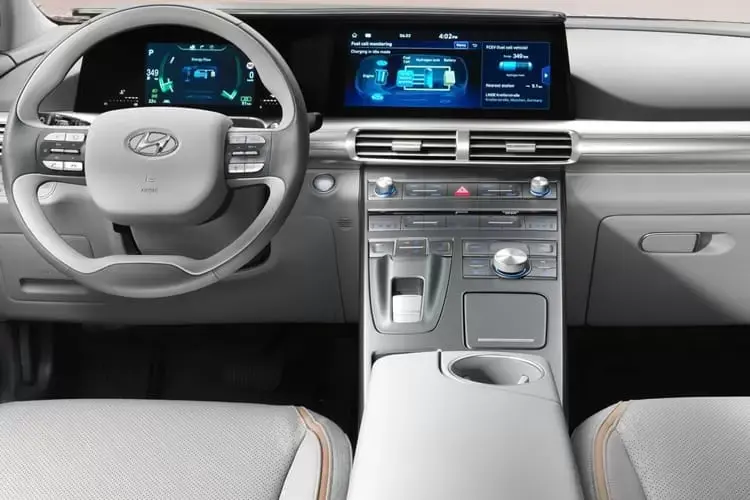
Using the Hyundai Nexo as a benchmark:
Full tank = 6.33kg
Average Cost of Standard Hydrogen/kg = £12.50
Efficiency = 0.9kg per 62 miles
Full tank = £79
Hydrogen running costs currently sit above petrol and diesel, and are broadly comparable to public rapid charging for EVs. Home EV charging remains the cheapest option by a significant margin.
Refuelling Time: Where Hydrogen Has the Edge
Despite its higher fuel costs, hydrogen offers one clear practical advantage: speed. A full hydrogen refuel takes around 3–5 minutes - virtually identical to filling a petrol or diesel car, and far quicker than even the fastest EV rapid chargers.
This makes hydrogen particularly well suited to:
∙ Fleet operators and high mileage drivers who can’t afford extended charging stops
∙ Drivers without access to home EV charging (around 52% of UK van drivers fall into this category)
∙ Commercial vehicles such as HGVs, buses, and taxis where downtime is costly
How Many Hydrogen Refuelling Stations Are There in the UK?
This is where the picture becomes genuinely challenging for private motorists. The UK’s public hydrogen refuelling network for passenger cars currently stands at fewer than 10–15 operational stations, with figures varying as some sites have closed in recent years.
The network is heavily concentrated in and around London, Birmingham, Sheffield, and parts of Scotland and Wales. For most UK drivers, a hydrogen car simply isn’t a viable daily option - you’d need to be close to one of these locations to make it work.
However, there are signs of expansion:
∙ Element 2 has announced 15 new hydrogen stations targeting key motorway corridors (M25, M1, M6, M74) planned for 2025–2026, primarily aimed at commercial vehicles
∙ Aegis Energy has secured £100 million in funding to build 30 new multi energy refuelling hubs by 2030, with the first sites due to open in Sheffield, Immingham, Warrington, Corby, and Towcester
∙ The UK’s National Hydrogen Strategy targets 5GW of low carbon hydrogen production capacity by 2030, backed by £900 million in confirmed investment
Most of this new infrastructure is geared toward heavy commercial vehicles and HGVs rather than passenger cars - which reflects where the business case for hydrogen is strongest right now.
Will Hydrogen Fuel Costs Come Down?
The long-term outlook for hydrogen pricing is encouraging. Costs are expected to fall as:
∙ Green hydrogen production scales up using renewable electricity
∙ Electrolyser technology improves and becomes cheaper to manufacture
∙ Mass adoption in commercial transport (buses, trucks, trains) drives economies of scale
∙ Major projects like the Source Energie Celtic Sea wind to hydrogen initiative could bring production costs down to as low as £1.50/kg by 2040
The challenge is bridging the gap between now and then - a “chicken and egg” problem where limited infrastructure discourages vehicle adoption, and limited vehicle adoption discourages infrastructure investment.
Is a Hydrogen Car Right for You?
For private motorists in 2026, hydrogen fuel cell vehicles remain a niche choice. Running costs are higher than petrol, diesel, or home charged EVs, and the UK refuelling network is still too sparse for most drivers to rely on. Lease costs for available models also remain high relative to comparable EVs.
That said, if you operate a fleet, drive high mileage, or need rapid refuelling and can’t charge at home, hydrogen is worth monitoring closely. The infrastructure and economics are improving - it’s a technology to watch rather than to dismiss.
So in the meantime if you are thinking about low-emission leasing? Explore our electric and hybrid lease deals at LetsTalk Leasing, or give our team a call on 0330 056 3331.