




























Types of Audi Hybrid Cars
Audi has one of the most comprehensive hybrid line-ups of any premium manufacturer. Whether you're researching Audi hybrid cars for a personal lease or trying to lower your company car tax bill, this guide explains every type of Audi hybrid available in 2026 - what the technology does, which models offer it, and which is right for you.
What is a hybrid car?
A hybrid car combines a conventional petrol engine with one or more electric motors. Depending on the type, it can run on electricity alone, on petrol alone, or on a blend of both - switching automatically to whichever is most efficient for the conditions.
Hybrid cars generally use electric power for lower speed urban driving and switch to (or add) the petrol engine for motorway speeds or when the battery is depleted. The result is lower fuel consumption and reduced CO₂ emissions compared with a conventional petrol equivalent.
In 2026, Audi manufactures two distinct types of hybrid car - mild hybrids (MHEV) and plug-in hybrids (PHEV) - and it is important to understand the difference before choosing a lease. More detail on hybrid cars are and how they work is available in our in depth guide.
The two types of Audi hybrid: MHEV and PHEV
Mild Hybrid Electric Vehicle (MHEV)
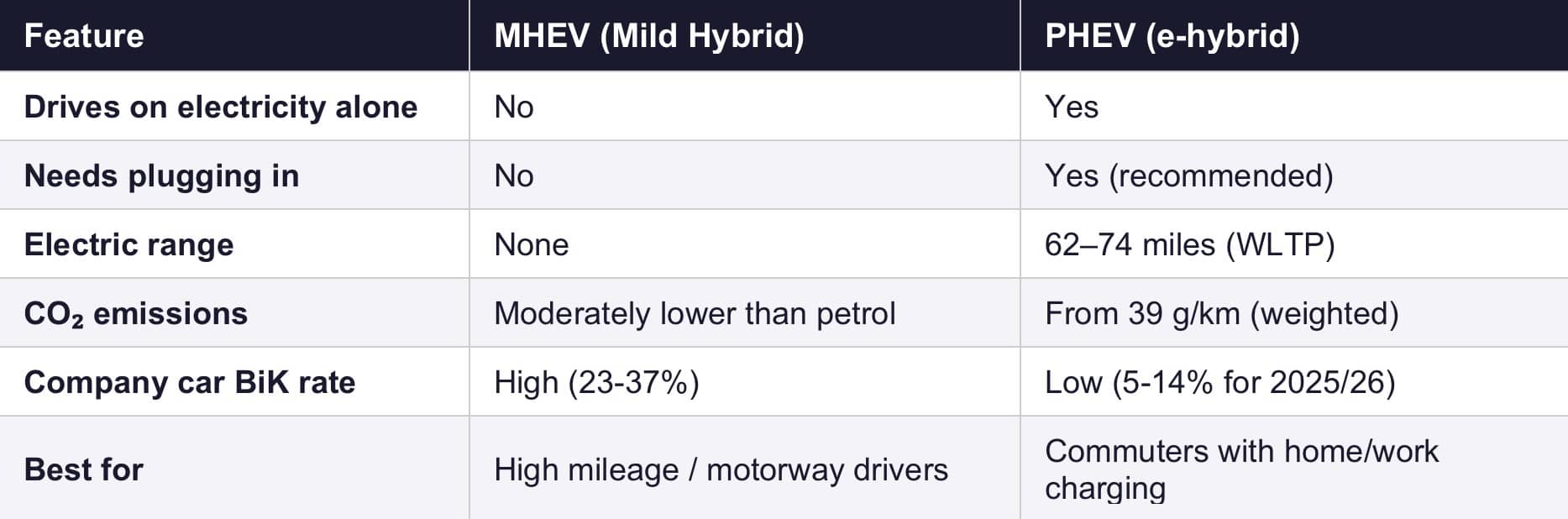
A mild hybrid uses a small electric motor - powered by a 12V or 48V battery - to assist the petrol engine during acceleration and coasting. An MHEV cannot drive on electricity alone and does not need to be plugged in. It simply reduces the load on the engine, offering modest improvements in fuel economy and CO₂ emissions.
Audi fits MHEV (or the more capable MHEV Plus) technology as standard across much of its petrol range in 2026, including the A5, A6, Q5, Q7 and Q8. For drivers who want an Audi with a little less fuel consumption but no change to their daily routine, an MHEV is the simplest option.
Plug-in Hybrid Electric Vehicle (PHEV) - now branded "e-hybrid"
An Audi PHEV pairs the petrol engine with a much larger high voltage battery and a dedicated electric motor. It can drive on electricity alone for a meaningful distance and - crucially - the battery can be charged by plugging into a home charger or public charging point, just like a full EV.
From 2025, Audi has unified all its plug-in hybrid models under the "e-hybrid" badge, making them easy to spot across the range. The new generation of e-hybrid batteries carries around 45% more energy than the previous models, with electric ranges of between 62 and 74 miles (WLTP) depending on the model - a significant step up from the 34–39 miles offered by the outgoing range.
Audi is launching 10 new e-hybrid models across 2025 and 2026. The Q3, Q5, A5 and A6 all now carry the new generation PHEV powertrain with larger batteries, faster AC charging (up to 11 kW), and DC fast-charging capability on selected models.
MHEV vs PHEV: Key Differences
What hybrid cars does Audi manufacture?
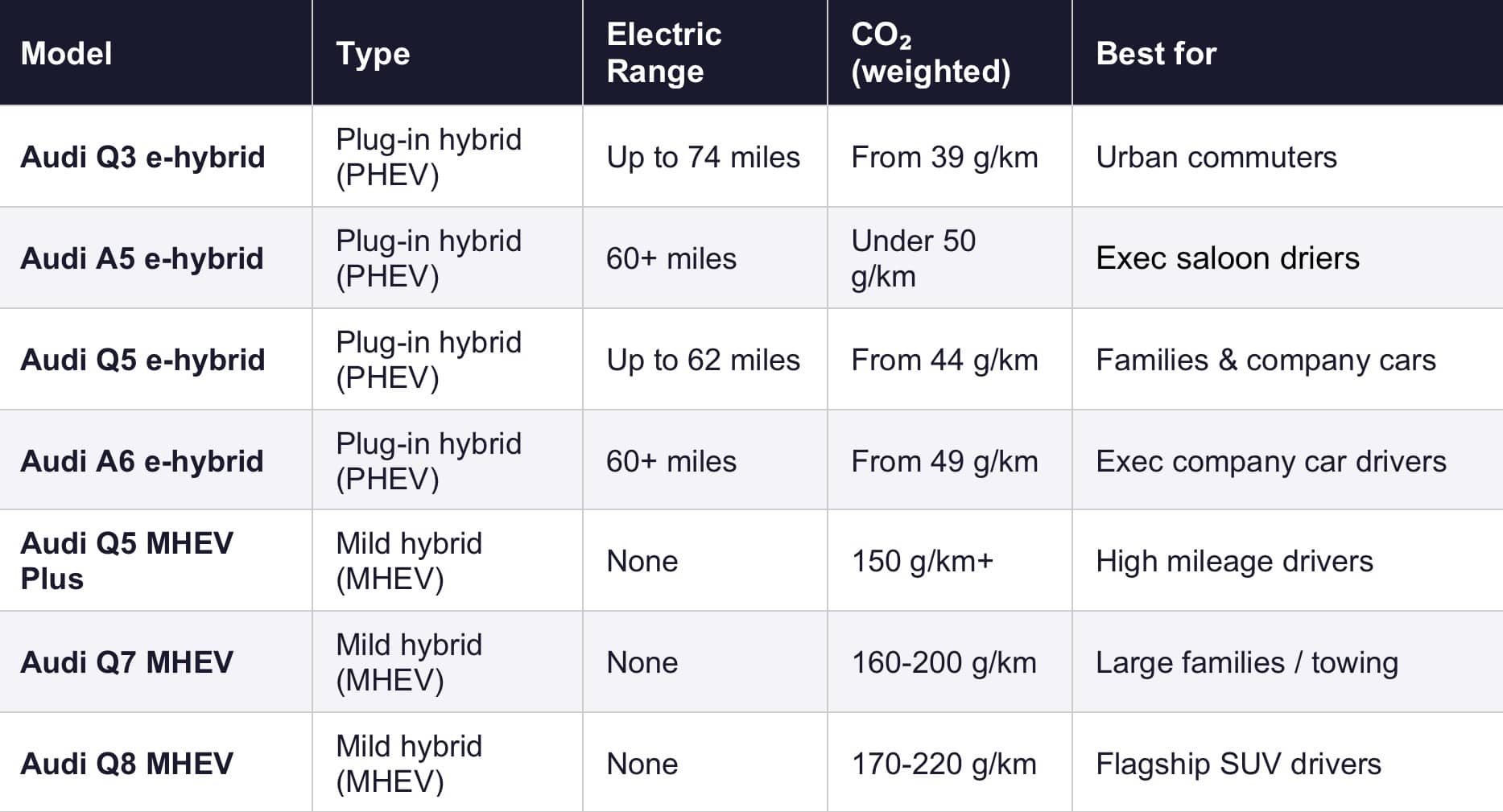
Audi has one of the broadest hybrid selections in the premium segment. Here at Let's Talk Leasing, we offer a range of popular Audi hybrid vehicles to lease, including the following models, which our specialists at LetsTalk Leasing have compared against each other, to help you choose you next lease car…
Audi also offers a growing range of fully electric (BEV) models to lease, including the Q4 e-tron, Q6 e-tron, A6 e-tron and Q8 e-tron. You can explore the full Audi electric and hybrid lease range here.
Does Audi sell a hybrid SUV?
Yes - and in 2026, the choice of Audi hybrid SUVs is better than ever. The three most popular options are the Q3, Q5 and Q7.
Audi Q3 e-hybrid
The Q3 e-hybrid is the most capable compact Audi hybrid SUV for urban driving. With up to 74 miles of all electric range (WLTP) and DC fast charging capability, it can cover most daily commutes on electricity alone. CO₂ emissions from 39 g/km (weighted combined) make it one of the most tax efficient Audi hybrids for company car drivers in 2026.
Audi Q5 e-hybrid quattro
The Audi Q5 SUV has been overhauled for 2026 with a new generation PHEV powertrain. It’s 25.9 kWh battery (up 45% over the previous generation) delivers around 62 miles of electric range - enough for most UK daily commutes in electric only mode. With 295 hp or 362 hp system outputs available, quattro all wheel drive as standard, and AC charging at up to 11 kW, the Q5 e-hybrid is one of the most well rounded hybrid lease options in its class.
Audi Q7 MHEV (and upcoming PHEV)
The Audi Q7 currently uses Audi’s 48V mild hybrid system across its petrol range, providing engine assistance without any plug-in charging. It remains a powerful, refined, and spacious choice for those who cover high annual mileages or regularly tow. A full PHEV version of the next-generation Q7 is arriving in 2026, expected to feature a larger battery pack and over 40 miles of electric range.
Tip: If you’re leasing a hybrid Audi SUV as a company car, the Q3 and Q5 e-hybrid models offer the best combination of low BiK rates and practical electric range for 2025/26. The Q7 MHEV, while powerful, sits in a higher BiK band due to its higher CO₂ figure.
Are Audi hybrids self-charging?
It depends on the type. Here’s how it works across the Audi hybrid range:
Audi MHEV models are fully self charging. Their small 12V or 48V battery tops up automatically as you drive, capturing energy during deceleration and braking. They never need to be plugged in, but they also cannot run on electricity alone.
Audi e-hybrid (PHEV) models also feature regenerative braking that recovers energy while you drive. However, regenerative charging alone is not sufficient to fully charge the larger high-voltage battery. To get the full benefit of the electric range - and the significant fuel and tax savings that come with it - Audi PHEVs should be plugged in regularly, ideally overnight at home or during the working day.
Most Audi hybrids available to lease in 2026 are plug-in hybrids. If you specifically want an Audi that never requires plugging in, look at the MHEV-badged variants of the Q5, Q7, and Q8.
Does the Audi hybrid charge whilst driving?
Yes - all Audi e-hybrid models feature a regenerative braking system that recovers kinetic energy every time you lift off the accelerator or apply the brakes, feeding it back into the high voltage battery.
The new generation of Audi e-hybrid models is a significant step forward here. The Q5 e-hybrid, for example, can recover up to 88 kW under braking - enough to handle around 90% of all real world braking scenarios without touching the mechanical brakes. The system uses navigation data, speed limits, and gradient information to manage regeneration intelligently, maximising the electric range available throughout your journey.
That said, regenerative braking alone will not fully replenish the battery on a day’s driving. For Audi PHEVs to deliver their full electric range, regular plug-in charging is essential. The Q5 and A6 e-hybrid now support 11 kW AC charging - a full charge takes around two hours on a home wallbox - and selected models support DC fast charging at up to 50 kW.
Audi hybrids and company car tax (BiK) in 2026
For business contract hire drivers, the Benefit in Kind (BiK) tax rate is one of the most important factors in choosing an Audi hybrid. The tax system rewards lower emission vehicles - and Audi’s e-hybrid range is well positioned.
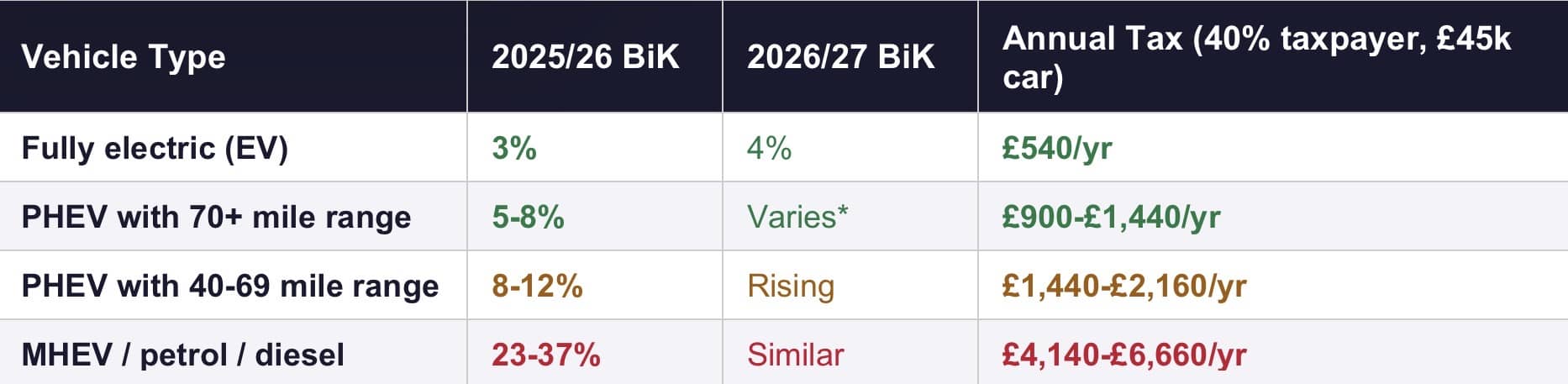
For the 2025/26 tax year, PHEVs emitting 1–50 g/km of CO₂ attract BiK rates of between 5% and 14% depending on electric range, compared to 23–37% for petrol and diesel models. A model like the Q5 e-hybrid - with its 62-mile range and weighted CO₂ from around 44 g/km - sits in a favourable band, potentially saving a higher rate taxpayer thousands of pounds per year versus an equivalent petrol Q5.
∙ Fully electric (EV): 3% BiK in 2025/26, rising to 4% in 2026/27 - approximately £540/yr tax for a 40% taxpayer on a £45k car
∙ PHEV with 70+ mile range: 5–8% BiK in 2025/26 - approximately £900–£1,440/yr
∙ PHEV with 40–69 mile range: 8–12% BiK in 2025/26 - approximately £1,440–£2,160/yr
∙ MHEV / petrol / diesel: 23–37% BiK - approximately £4,140–£6,660/yr
From April 2026, all PHEVs are being re-tested under the stricter Euro 6e-bis standard. Models with longer electric ranges are better insulated from any CO₂ increases this may cause.
Looking ahead: From the 2028/29 tax year, all PHEVs will move into an 18% BiK band regardless of range. Fleet managers planning 3–4 year leases that stretch into 2028 should factor this into total cost of ownership calculations. Fully electric Audi models remain the most tax-efficient long-term option, with EV BiK rising only to 9% by 2029/30.
For more information on business car leasing and the tax benefits available, visit our dedicated business car leasing guide.
Meanwhile, 2026/27 Audi BiK rates can be found below.
Which Audi hybrid should I lease?
The right choice depends on how you drive, whether you can charge, and whether you’re leasing personally or as a company car driver.
Choose an e-hybrid (PHEV) if:
∙ You commute under 40 miles a day and can charge at home or work
∙ You’re leasing as a company car and want a low BiK rate
∙ You want the option to drive on electricity for short trips
∙ You want access to zero emission zones or lower congestion charges
∙ Performance matters - both power options offer strong combined outputs
Choose an MHEV if:
∙ You cover high annual mileages, mostly on motorways
∙ You have no access to home or workplace charging
∙ You want the simplest possible driving experience
∙ You need a larger SUV like the Q7 or Q8 and electric range isn’t a priority
If you need more help or advice with choosing the right Audi hybrid for you, get in touch with our team by giving us a call on 0330 056 3331.