



























Electric Car Leasing : The Complete FAQ Guide
Everything You Need to Know Before Leasing an Electric Vehicle in 2026.
• Business Leasing
• EV Range
• Charging
• Costs
• Tax Benefits
Electric vehicle (EV) leasing is rapidly becoming the most popular way for UK drivers and businesses to get behind the wheel of a brand-new electric car. With lower monthly payments compared to buying outright, zero deposit options, and a constantly evolving market of new electric models, leasing an EV in 2026 has never been more attractive - or more confusing.
This comprehensive guide answers every frequently asked question about electric car leasing, covering everything from how electric vehicle leases work and what the monthly payments include, to government grants, charging infrastructure, battery warranties, and business car leasing vs personal car leasing. Whether you're a first-time EV lessee or an experienced fleet manager, this is your ultimate one-stop-shop for electric car leasing information.
68% of new EV registrations are leased
£299 average EV lease from per month
400+ miles range on latest EV models
What Is Electric Car Leasing? - The Basics Explained
What does it mean to lease an electric car?
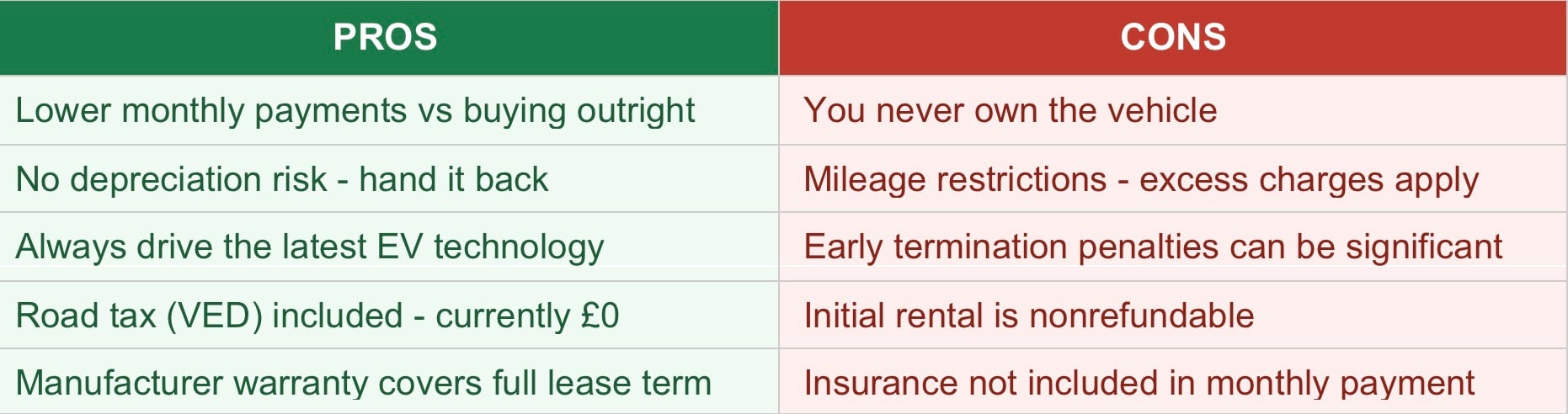
Electric car leasing - also known as Personal Contract Hire (PCH) for private individuals or Business Contract Hire (BCH) for companies - means you pay a fixed monthly amount to use a brand new electric vehicle for an agreed term (usually 24–48 months) and a set annual mileage allowance. At the end of the lease, you simply hand the car back. You never own the vehicle, which is why monthly payments are significantly lower than financing a purchase.
Q: Is leasing an EV different from leasing a petrol or diesel car?
A: The leasing process itself is identical - you agree a term, mileage, and monthly payment. However, EV leases often include additional considerations such as battery health guarantees, home charging equipment, and specific mileage restrictions that account for charging behaviour. Some EV leases also include free or subsidised home charger installation as part of the package.
What is Personal Contract Hire (PCH) for electric vehicles?
Personal Contract Hire (PCH) is the most common form of electric car leasing for private individuals. You pay an initial rental (typically equivalent to 1–9 months' payments) followed by fixed monthly payments. Road tax (Vehicle Excise Duty) is included, and most PCH deals include a maintenance package option. At the end of the term, you return the car - no balloon payments, no depreciation risk, no hassle.
Q: What is the difference between PCH and PCP for electric cars?
A: PCH (Personal Contract Hire) means you rent the car with no option to buy - you simply return it. PCP (Personal Contract Purchase) is a finance agreement where you make monthly payments and have the option to buy the car at the end by paying a 'balloon' or Guaranteed Minimum Future Value (GMFV). PCH typically has lower monthly payments since you're only paying for depreciation with no residual value option. For most EV drivers who want to upgrade to the latest model every 2–4 years, PCH leasing is the more cost-effective route.
Electric Car Leasing Costs - What You'll Actually Pay
How much does it cost to lease an electric car in 2025?
Electric car lease prices in 2025 vary significantly depending on the model, term length, mileage allowance, and initial rental amount.
Q: What is included in an electric car lease monthly payment?
A: Your monthly EV lease payment typically covers: vehicle depreciation (the main cost driver), road tax (VED - currently £0 for zero-emission vehicles), manufacturer's warranty, and breakdown cover. It does NOT typically include insurance, electricity for charging, or a home charger. Optional maintenance packages can be added to cover servicing, tyres, and MOTs for a fixed additional monthly cost.
What is an initial rental and how does it affect my monthly payments?
The initial rental is an upfront payment made at the start of your lease, typically equivalent to 1, 3, 6, or 9 months' worth of payments. Paying a higher initial rental reduces your monthly costs - for example, a 9 month initial rental on a deal advertised at £299/month with a 3 month initial, would result in lower subsequent monthly payments. It's important to note that initial rental payments are non-refundable if you cancel early, so never pay more than you can afford to lose.
Q: Can I lease an electric car with zero deposit?
A: Yes - many electric car leases are advertised with a 1 month initial rental, which functions similarly to a zero deposit arrangement. Some specialist EV lease deals do offer true zero deposit options, particularly through business channels. However, zero or low initial rental deals typically come with slightly higher monthly payments to compensate.
Are there any hidden costs in electric car leasing?
Transparency varies by broker and manufacturer. Always check for the following potential additional costs before signing any EV lease agreement:
• Excess mileage charges - typically 5p–30p per mile over your agreed annual mileage allowance
• Fair wear and tear charges - damage beyond normal use at vehicle return
• Early termination fees - usually 50% of remaining rentals if you exit early
• Admin or documentation fees - charged by some brokers, not all
• Home charger installation - not always included; can cost £500–£1,200 separately
• Gap insurance - optional but recommended to cover the difference between insured value and outstanding lease in a write-off
Electric Vehicle Range & Charging - What Lessees Need to Know
Q: How far can I drive on a single charge with a leased electric car?
A: Real-world electric car range in 2026 varies considerably by model, speed, weather, and driving style. WLTP (Worldwide Harmonised Light Vehicle Test Procedure) range figures are manufacturers' official estimates tested under standardised conditions. Expect real-world range to be 10–20% lower in cold weather or at motorway speeds.
Q: Will I need to install a home charger when leasing an electric car?
A: While not legally required, a home charger (also called an EVSE - Electric Vehicle Supply Equipment) is strongly recommended. A standard 3 pin plug can deliver 2.3kW, which is very slow. A dedicated home wallbox (7kW–22kW) typically adds 20–30 miles of range per hour of charging and is far more practical. The UK government's Electric Vehicle Chargepoint Grant (EVCG) provides up to £350 towards home charger installation for those in flats or rental accommodation. Many EV lease deals now include a home charger as part of the package - always ask your leasing provider.
Q: How much does it cost to charge a leased electric car?
A: Charging costs vary significantly depending on your tariff and charging location. At home on a standard tariff (28p/kWh in 2025), charging a 75kWh battery from empty costs approximately £21 and provides 300 miles of real-world range - equivalent to about 7p per mile. On a smart off-peak EV tariff (e.g., Octopus Go at ~9p/kWh), this drops to around £6.75 per full charge. Public rapid chargers typically cost 65p–85p/kWh, bringing the cost closer to 20–25p per mile - still competitive with petrol or diesel running costs.
Q: What happens if I run out of charge in my leased electric car?
A: Most leased EVs include breakdown cover that will transport you and the car to the nearest charging point. It's also worth noting that almost all modern electric vehicles include features to help prevent this - real-time range estimation, route planning with charging stops, and low battery warnings. Planning your journeys using apps like Zap-Map, ABRP (A Better Route Planner), or the car's native navigation greatly reduces range anxiety.
EV Battery Warranties, Health & Technology
Q: What happens to the battery in my leased electric car - am I responsible?
A: No - during your lease term, the electric vehicle battery is covered by the manufacturer's battery warranty. Most manufacturers provide an 8-year/100,000-mile battery warranty guaranteeing a minimum state of health (typically 70–75% capacity retention). Since you're leasing and not owning the vehicle, battery degradation risk sits with the leasing company and manufacturer, not with you. This is one of the key advantages of leasing an EV versus buying.
Q: How long do electric car batteries last?
A: Modern EV batteries are engineered to last significantly longer than early generation electric vehicles. Real world data from Tesla, Nissan, and Hyundai vehicles shows that after 150,000–200,000 miles, most EV batteries retain 80–90% of their original capacity. For the typical lessee doing 8,000–15,000 miles per year on a 2–4 year lease, battery degradation during the lease term will be negligible - typically less than 3–5%.
Q: Should I charge my leased EV to 100% every time?
A: For daily use, it's generally recommended to charge to 80% as a matter of routine to optimise long-term battery health. Most EV manufacturers and leasing companies recommend keeping charge between 20–80% for daily driving, only charging to 100% for long journeys. Many EVs allow you to set a default charge limit directly in the vehicle's settings. Since you're leasing, though, the battery is covered by warranty - so this is more of a best-practice tip than a strict requirement.
Business Electric Car Leasing - Tax Benefits & Fleet FAQs
What are the tax advantages of leasing an electric car through a business?
Business electric car leasing (Business Contract Hire / BCH) offers some of the most compelling tax advantages of any company vehicle strategy in 2026:
Q: What is Benefit-in-Kind (BiK) tax on leased electric cars and how do I calculate it?
A: Benefit-in-Kind (BiK) tax is charged when employees use a company car for personal journeys. For electric vehicles in 2025/26, the BiK rate is just 3% of the car's P11D value (list price including options, excluding first-year registration fee). Example: A Tesla Model 3 with a P11D value of £42,990 would have an annual BiK value of £1,289.70 (3%). A 20% taxpayer would pay £257.94/year in BiK tax - or just £21.49 per month. Compare this to a similarly priced BMW 5 Series petrol at 30% BiK, costing over £2,500/year in BiK tax, and the EV advantage becomes crystal clear. Check out our own BiK Calculator by clicking here
Q: Can a sole trader or self-employed person lease an electric car through their business?
A: Yes. Sole traders and self employed individuals can lease an electric vehicle through their business and claim the lease payments as a business expense against their tax bill. Unlike limited companies, sole traders cannot reclaim VAT unless VAT-registered, but the income tax deduction on lease payments still provides a significant saving. If the vehicle is used for both business and personal use, only the business-use proportion of the lease cost is tax deductible.
Pros & Cons of Electric Car Leasing
Government Grants & Incentives for EV Leasing in 2025
The UK government and devolved administrations offer several incentive schemes that can make leasing an electric car even more financially attractive, as outlined below.
Electric Vehicle Chargepoint Grant (EVCG)
The Electric Vehicle Chargepoint Grant (EVCG) is available to people in flats or rental accommodation who have off-street parking, this grant provides up to £350 (or 75% of installation cost, whichever is lower) towards the cost of a home EV charger. Landlords, renters, and flat owners can all apply. Owner-occupiers in houses are no longer eligible for this grant, but many EV lease deals now include charger installation as part of the package.
Workplace Charging Scheme (WCS)
Using the Workplace Charging Scheme (WCS), businesses, charities, and public sector organisations can apply for up to £350 per socket (maximum 40 sockets) to install workplace EV charging points. This complements business EV leasing perfectly, enabling employees to charge company cars at work tax-efficiently.
Q: Is there still a plug-in car grant for electric vehicles in 2026?
A: The UK government's plug-in car grant for private EV purchases was discontinued in June 2022. However, the plug-in van grant and plug-in motorcycle grant remain available in 2026. Northern Ireland, Scotland, and Wales have their own supplementary incentive programmes - always check with your regional transport authority for up-to-date grants before signing a lease agreement.
How to Lease an Electric Car - Step by Step Process
Leasing an electric vehicle is a straightforward process when broken down into clear steps:
1. Step 1: Determine your budget - decide on a monthly budget including insurance, electricity, and any maintenance package
2. Step 2: Choose your lease term - 24, 36, or 48 months, balancing payment level vs flexibility
3. Step 3: Set your annual mileage allowance - be realistic; underestimating leads to costly excess mileage charges
4. Step 4: Select your initial rental - a larger upfront payment reduces monthly costs but is non-refundable
5. Step 5: Compare EV lease deals - use a FCA-regulated leasing broker to compare deals across multiple funders
6. Step 6: Check eligibility for government grants - EVCG, WCS, and any regional incentives
7. Step 7: Complete a credit application - leasing companies will conduct a soft or hard credit search
8. Step 8: Review and sign your lease agreement - check all terms, excess mileage rates, and wear and tear standards
9. Step 9: Arrange home charger installation - ideally before vehicle delivery
10. Step 10: Take delivery of your electric car - inspect thoroughly at handover and document any pre-existing marks
Q: What credit score do I need to lease an electric car?
A: Most leasing companies require a good to excellent credit score - broadly equivalent to 670+ on Experian's scale or 'Good' on Equifax. However, criteria vary by funder. Some specialist EV leasing companies cater for near-prime applicants. Having CCJs, active bankruptcies, or multiple recent credit applications can make approval more difficult. A larger initial rental can sometimes offset credit concerns for borderline applications.
End of Electric Car Lease - What Happens Next?
Q: What happens at the end of my electric car lease?
A: At the end of your EV lease term, you have three main options: (1) Simply return the vehicle and walk away - the most common choice for EV lessees who want to upgrade to the latest model; (2) Extend your current lease - many funders allow 3–12 month extensions at a revised monthly rate; (3) In some cases with PCH, you may be able to negotiate to purchase the vehicle, though this is not always available or financially advantageous.
Q: What is 'fair wear and tear' for a leased electric car?
A: Fair wear and tear refers to the expected, normal deterioration of a vehicle through regular use. The British Vehicle Rental and Leasing Association (BVRLA) publishes official fair wear and tear guidelines used by leasing companies to assess returned vehicles. Scratches under 25mm and minor scuffs that can be polished out are generally acceptable. Larger scratches, dents, chips in the windscreen, damaged alloys, and interior staining may incur charges. Always take photographs of your vehicle at return.
Q: Can I end my electric car lease early?
A: Yes, but early termination of an EV lease carries significant financial penalties. Most leasing agreements charge 50% of remaining monthly rentals as an early termination fee. For example, terminating an agreement 12 months early on a £400/month lease would incur a £2,400 penalty. Some leasing companies offer 'lease transfer' options, allowing another person to take over your agreement - this can be a more cost-effective exit route.
Quick-Fire Electric Car Leasing FAQs
Q: Can I take my leased EV abroad?
A: Yes, most PCH agreements allow EU travel for up to 30–90 days per year. Always notify your leasing company and insurer before travelling abroad with a leased electric car.
Q: Is insurance included in an EV lease?
A: No - insurance is always the lessee's responsibility. Leased vehicles must be covered by fully comprehensive insurance at minimum.
Q: Can I add a tow bar to a leased electric car?
A: Modifications to leased vehicles are generally not permitted without prior written consent from the leasing company. Some EVs do support factory fitted tow bars - check at order stage.
Q: What happens if my leased EV is involved in an accident?
A: Report to your insurer immediately. If the car is written off (total loss), gap insurance covers the difference between the insurer's payout and the outstanding lease value - strongly recommended for EV leases due to higher vehicle values.
Q: Do I need gap insurance for a leased electric car?
A: Gap insurance (specifically 'Contract Hire Gap') is highly recommended for leased EVs. It covers the shortfall between the insured value paid out after a total loss and the outstanding lease payments owed to the funder.
Q: Can I lease an electric car with bad credit?
A: It's more difficult but not impossible. Specialist brokers work with a broader panel of funders. A larger initial rental, a guarantor, or a shorter lease term may help. Avoid multiple hard searches if declined - use brokers who conduct soft searches first. Check out more information about leasing with bad credit by clicking here.
Q: What is the minimum age to lease an electric car?
A: You must be at least 18 years old to enter a lease agreement in the UK. Most mainstream leasing companies prefer applicants aged 21+ with established credit histories.
Q: Can I lease an electric car if I'm on a visa?
A: Yes, in most cases. UK residents on a valid visa can lease an EV. You'll typically need to have been UK resident for at least 12 months and have a UK credit history. Requirements vary by funder.
So Is Leasing an Electric Car Right for You?
Electric car leasing in 2026 represents one of the most financially sensible and practical ways to drive a zero emission vehicle. With exceptionally low Benefit-in-Kind tax rates for businesses, zero road tax, rapidly improving ranges exceeding 400 miles, and a constant stream of new EV models entering the market, especially from Chinese manufacturing firms, leasing gives you flexibility and value that buying simply cannot match for most drivers.
The key is doing your homework: understand your mileage needs, calculate the true total cost of lease including insurance and charging, take advantage of government grants, and always read the small print on excess mileage and wear and tear. Use a reputable, FCA regulated EV leasing broker to compare deals across multiple funders and ensure you're getting the most competitive electric car lease available.
Whether you're an individual wanting to reduce your carbon footprint with the latest technology, or a business looking to maximise tax efficiency through a fleet of electric vehicles, EV leasing is - for most people - the smartest route into electric motoring today. If you’d like to know more about Electric vehicle fleet leasing, then check out our sister company, LetsTalk Fleet, for all of your business enquiries and specialist fleet solutions.
Ready to Find Your Perfect Electric Car Lease?
Compare hundreds of EV lease deals from UK's leading funders.
Compare deals by Monthly Budget, Manufacturer, Car Type or Emissions, using our Smart Comparisons tool.
Alternatively, contact one of our friendly customer service advisors on 0330 056 3331, or click here to enquire, and we will respond within 10 minutes during business hours.