



























How Does a Business Car Lease Work? A Complete Guide for UK Businesses and Employees 2026
If you’re wondering how a business car lease works in the UK, you’re not alone. Business car leasing has become one of the most popular and tax-efficient ways for companies to fund vehicles in 2026 - helping businesses manage cash flow while avoiding large upfront purchase costs.
Whether you’re a company director arranging vehicles for your fleet or an employee joining a company car scheme, understanding how Business Contract Hire (BCH) works, what tax benefits are available, and how Benefit-in-Kind (BiK) is calculated is essential before signing an agreement.
In this complete 2026 guide, we explain:
What a business car lease is
How Business Contract Hire works
The tax advantages, including VAT reclaim and corporation tax relief
How company car schemes operate for employees
Salary sacrifice car schemes explained
What happens at the end of a lease
By the end of this guide, you’ll know exactly how business car leasing works - and whether it’s the right option for you or your company.
What Is a Business Car Lease?
A business car lease works by allowing a company to rent a vehicle for a fixed term and mileage in exchange for monthly payments. The business pays for depreciation rather than ownership and returns the vehicle at the end of the agreement.
Unlike financing options such as hire purchase, you don’t own the car at the end of the agreement.
How Does a Business Car Lease Work?
Here is a step-by-step breakdown:
1. Choose Your Vehicle
You select the make, model and specification that suits your business needs — from compact city cars to executive SUVs or electric vehicles.
2. Agree the Contract Terms
You’ll decide on:
Contract length (typically 24-48 months)
Annual mileage allowance
Initial rental (usually 3-12 months upfront)
Whether to include a maintenance package
3. Pay Fixed Monthly Rentals
Your business pays fixed monthly payments for the duration of the lease. These are based on:
Vehicle value
Contract length
Estimated depreciation
Mileage allowance
4. Return the Vehicle
At the end of the lease, the vehicle is returned to the finance provider (subject to fair wear and tear guidelines). There’s no need to worry about selling it or depreciation.
Who Can Get a Business Car Lease?
Business leasing is available to:
Limited companies
Sole traders
Partnerships
LLPs
VAT-registered businesses
Some non-profit organisations
You’ll usually need to pass a credit check, and lenders may request business financial details.
What Are the Tax Benefits of Business Car Leasing?
One of the biggest advantages of business leasing is the potential tax efficiency.
VAT Reclaim
If your business is VAT registered:
You can typically reclaim 50% of the VAT on monthly rentals (if there is personal use).
You can usually reclaim 100% of the VAT if the vehicle is used exclusively for business.
You can reclaim 100% of the VAT on maintenance packages.
All as outlined by HMRC.
Corporation Tax Relief
Monthly lease payments are usually treated as a business expense and can often be offset against corporation tax.
However, vehicles with CO₂ emissions over 50g/km may have restricted tax relief, while low-emission and electric vehicles offer greater benefits.
What Is Business Contract Hire (BCH)?
Most business car leases in the UK are structured as Business Contract Hire (BCH).
BCH means:
You never own the vehicle
You pay for the vehicle’s depreciation over the lease term
There is no balloon payment at the end
You simply return the vehicle
It is designed for businesses that want predictable costs without ownership responsibilities.
Electric Vehicle Business Leasing
Electric vehicles (EVs) are increasingly popular for business leasing thanks to tax incentives and lower running costs.
Models like the Tesla Model 3, BMW i4 and Hyundai Kona Electric offer:
Low Benefit-in-Kind (BiK) tax for company car drivers
Zero road tax (currently, yet changes are due to be implemented. More information on this can be found by clicking here)
Lower maintenance costs
Strong environmental credentials
For directors taking a company car, EVs can significantly reduce personal tax liability.
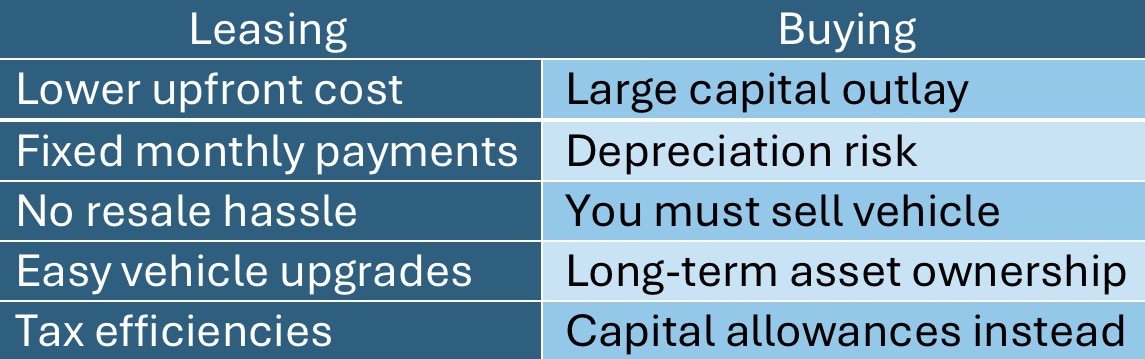
Business Car Lease vs Buying
Here is a quick comparison:
What Happens at the End of the Lease?
When your contract finishes:
The leasing company arranges vehicle collection.
The car is inspected under fair wear and tear guidelines.
Excess mileage or damage charges may apply (if applicable).
You’re free to lease a new vehicle.
Many businesses use leasing to refresh their fleet every 2–3 years.
How Does a Company Car Scheme Work for Employees?
If you’re employed by a company that offers a company car scheme, the process works slightly differently from a standard business lease arranged by the business owner.
A company car scheme allows employees to drive a vehicle funded and managed by their employer — usually through a Business Contract Hire agreement.
What Is a Company Car Scheme?
A company car scheme is a benefit provided by an employer. Instead of receiving a cash allowance to arrange your own vehicle, the company leases the car on your behalf and assigns it to you for business and often personal use.
The vehicle is not owned by you, it remains under the company’s lease agreement.
How the Process Typically Works
Here’s how most schemes operate:
1. Vehicle Selection
Your employer provides a list of approved vehicles within a set budget or grade level.
2. Lease Agreement Setup
The company arranges the business lease agreement with a finance provider.
3. Vehicle Delivery
The car is delivered to you, and you can use it for business and (usually) personal driving.
If the vehicle is available for personal use, you’ll pay Benefit-in-Kind tax through your salary.
5. End of Contract
At the end of the lease term (typically 2-4 years), the vehicle is returned and you may choose a new one.
Understanding Benefit-in-Kind (BiK) Tax
Because a company car is considered a benefit, HMRC requires employees to pay tax on its value if it’s available for personal use.
The amount you pay depends on:
The car’s P11D value (list price)
Its CO₂ emissions
The fuel type
Your income tax bracket
Salary Sacrifice Car Schemes
Some businesses now offer salary sacrifice schemes, particularly for electric vehicles.
Under this arrangement:
You agree to reduce your gross salary
In return, the employer provides a leased vehicle
Payments are taken before tax and National Insurance
You may benefit from additional tax efficiencies
This option has grown rapidly in popularity due to favourable government incentives for low-emission vehicles.
Is a Business Car Lease Right for You?
A business car lease works well if you:
Want predictable monthly costs
Prefer not to tie up capital
Need to manage fleet expenses efficiently
Like upgrading vehicles regularly
Want potential VAT and tax advantages
For employees, a company car scheme may suit you if you value convenience, drive regularly for work, or want to take advantage of low BiK rates on electric vehicles.
Key Things to Consider Before Leasing and Potential Drawbacks
Before signing a contract, think about:
Accurate annual mileage estimates
Driver Benefit-in-Kind implications
Insurance requirements
Early termination charges
Maintenance inclusion
Taking the time to structure the agreement correctly can save money over the long term.
A business car lease is a flexible, tax-efficient and cost-effective way for UK businesses to run vehicles without the burden of ownership.
Whether you’re a company director arranging vehicles for your fleet or an employee joining a company car scheme, understanding how the structure works - particularly the tax implications - ensures you make an informed decision.
By spreading costs over fixed monthly payments and avoiding depreciation risk, businesses can protect cash flow while maintaining a modern, professional fleet.
As briefly mentioned earlier, there has been changes made to Road taxes this year, and these changes are all explained within the article below, written by one of our experts here at LetsTalk Leasing. Find out more by clicking here.
Why choose to lease a company vehicle from LetsTalk Leasing?
At Let’sTalk Leasing, we’re proud to be among the top car and van leasing companies in the UK.
We’ve created one of the most straightforward leasing experiences out there; no jargon or hidden fees – just a simple, transparent service, and affordable deals on the best models.
With a five-star rating on Google reviews and more than 9,875 lease deals to choose from, we can help you drive the car you want at a price you can afford.
Use our Car Lease Comparison tool to find the perfect vehicle and deal for you.
Browse all of our business lease deals online, or give our team a call on 0330 056 331 if you need help choosing the right car or deal for you.